Stepper Motor
XFOYO is a national high-tech enterprise focusing on the research and development, production and sales of motion control products. Our company mainly develops and produces stepper motor, stepper driver, servo motor, servo driver, brushless motors, brushless driver and motion controllers, plc, hmi and other products. Our factory has many types of stepper motor, including 2 phase stepper motor, 3 phase stepper motor, integrated stepper motor, etc. These motors are widely used in electronic equipment, textile equipment, medical equipment, advertising equipment, robots and other fields.


Why Choose Us?
Rich Experience
SHENZHEN XFOYO ELECTRIC CO., LTD. is established in 2009, is a national high-tech enterprise focusing on the research and development, production and sales of motion control products.
Quality Guaranteed
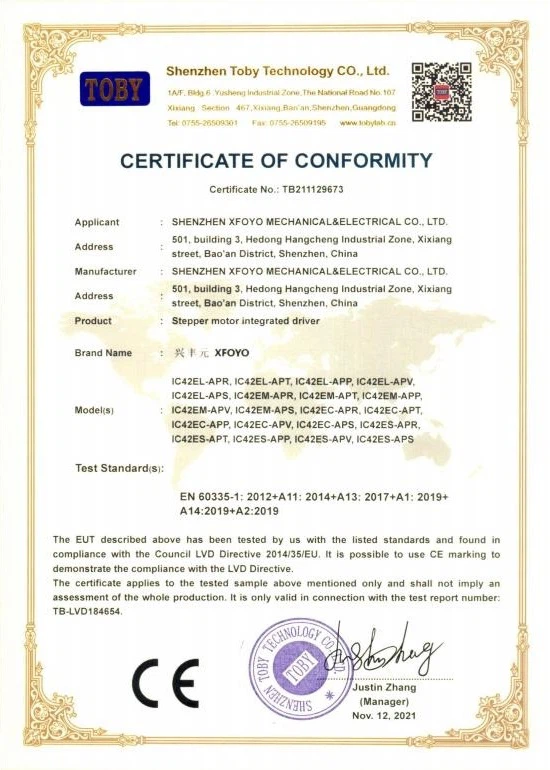
All XFOYO products have passed CE, FCC, UL, RoHS and other certifications, and professional quality management personnel conduct product testing to ensure product quality.
Wide Product Range
XFOYO products are widely used in semiconductor equipment, robots, medical equipment, textile equipment, digital post printing equipment, clothing plotters, packaging machinery, carving machines, sewing equipment, laser equipment and other industries.
Broad Market
All products manufactured by the factory are exported to over 20 countries, and original equipment manufacturing (OEM) services are also available upon request.
Types of Stepper Motor
2 Phase Stepper Motor
A 2-phase stepper motor, also known as a bipolar stepper motor, is a type of electric motor that rotates in discrete angular steps, controlled by a sequence of electrical pulses, and typically has two windings, each connected to a separate phase.
3 Phase Stepper Motor
A 3-phase stepper motor uses three coils driven by three synchronized signals, offering smoother and more precise movement compared to 2-phase motors, and is often used in applications requiring high torque and smooth operation.
Integrated Stepper Motor
An integrated stepper motor combines a stepper motor, its driver, and sometimes a controller and encoder, all into a single, compact unit, simplifying wiring and reducing space requirements while offering cost savings and ease of implementation.
|
Model No |
Step Angle (°) |
Motor Length |
Holding Torque |
Rated Current (A) |
Phase Resistance (Ω) |
Phase Inductance (mH) |
Rotor Inertia (g.cm²) |
Weight (Kg) |
Wires |
|
|
(mm) |
Nm |
Oz/in |
||||||||
|
FY110ES500A |
1.8 |
100 |
11 |
1571.4 |
5 |
0.9 |
11.5 |
5500 |
5.1 |
4 |
|
FY110EM600A |
1.8 |
120 |
14 |
2000 |
6 |
0.44 |
4.9 |
10500 |
6.3 |
4 |
|
FY110EL600A |
1.8 |
150 |
22 |
3142.9 |
6 |
0.8 |
9.4 |
16000 |
8.5 |
4 |
|
FY110EC600A |
1.8 |
165 |
24 |
3428.6 |
6 |
0.62 |
11 |
22000 |
9.5 |
4 |
|
FY110ED600A |
1.8 |
200 |
28 |
4000 |
6 |
0.58 |
9.8 |
25000 |
10.5 |
4 |
Functions of Stepper Motor


Flexibility
Stepper motors offer flexibility in application for a wide range of applications because the design of the stepper motor provides a constant holding torque without the need for the motor to be powered.
Greater Torque
The torque of a stepper motor of that of the same size of a servo motor, at lower speeds is greater than that of a servo motor.
Cheaper than Servo Motors
The Stepper Motor is often used in an Open Loop System that does not require positional or torque feedback making the Stepper Motor simpler and less costly to control.
Stepper Motors are Considered to be Safer
Stepper Motors are considered to be safer, where as if anything breaks, the Stepper Motor will stop.
Stepper Motor Offer a Longer Life
Many of the moving parts are frictionless, so it is considered that Stepper Motor offer a longer life when considering that the bearings are essentially the only part that will wear-out.
Excellent Low Speed Torque
And Stepper Motors offer excellent low speed torque, which means, the motor will drive many loads without having to utilize any additional gearing or gearbox mechanisms.
Excellent Repeatability
Steppers provide precise positioning and repeatability of movement since good stepper motors have an accuracy of 3 – 5% of a step and this error is non-cumulative from one step to the next.
Stepper Motors are Overload Safe
The Stepper Motor is essentially overload safe. The motor cannot be damaged by mechanical overload, but positional loss may occur effecting accuracy and repeatability when the load increases beyond design.
The Rotation Angle of the Stepper Motor is Proportional to the Input Pulse.
Stepper motor is a motor whose rotation angle is proportional to the input pulse. One digital pulse output from the controller driver is equivalent to one step of rotation.
Stepper Motors Provide Full Torque at Standstill
Stepper motors are able to provide maximum torque when the windings are energized and the rotor is stationary. This is also known as holding torque, which means the motor can hold the load in place without the rotor rotating.
Very Reliable
Stepper Motors are very reliable since there are no contact brushes in the motor. Therefore, the life of the motor is simply dependent on the life of the shaft bearing.
Low-speed Synchronous Rotation
With Steppers it is possible to achieve very low speed synchronous rotation with a load that is directly coupled to the shaft and a wide range of rotational speeds can be realized as the speed is proportional to the frequency of the input pulses.
Good Choice for Applications Requiring Low Speed with High Precision.
Normal DC motors do not have very much torque at lower speeds however, a Stepper Motor has maximum torque at low speeds, so this makes Steppers a good choice for applications requiring low speed with high precision.
Customization Options
Material:
Customizable
Color:
Customizable
Style:
Customizable
Warranty:
One year
Logo:
Can print your private logo according to your requirements
Minimum order quantity:
We have flexible minimum order quantity
Installation Requirements of Stepper Motors
The indicator light PWR of Integrated Stepper Motor Driver RS485 Control is on when the starter is powered on, and the light is off when the driver is powered off or the driver is faulty.
Do not connect the power supply in reverse, and the input voltage of the Integrated Stepper Motor Driver RS485 Control should not exceed DC36V.
When the motor is installed, it is strictly forbidden to hit the motor shaft and the back cover, so as not to damage the encoder of the Integrated Stepper Motor Driver RS485 Control.
Applications of Stepper Motors
Stepper motors are diverse in their uses, but some of the most common include:
3D printing equipment
Textile machines
Printing presses
Gaming machines
Medical imaging machinery
Small robotics
CNC milling machines
Welding equipment
While these applications are the most common, they're a fraction of what stepper motors can be used for. Generally speaking, any application that requires highly accurate positioning, speed control, and low speed torque can benefit from the use of stepper motors.
|
Payment method: |
T/T, Western Union, PayPal etc. |
|
Pay 30-50% deposit first, The balance needs to be paid before shipment |
|
|
Shipping method: |
By Sea, Air, Express and Other Channels |
Certificate